THE ENVIRONMENT IN WHICH WE OPERATE
The hotels business in South Africa is highly competitive and, since the barriers to entry are low it is often the case that additional, and in some cases, unviable supply, is added to the market.
Whilst these hotels inevitably experience financial distress, the room stock once built does not exit the market, and it can take a substantial period of time for demand to catch up to supply.
Following the first democratic elections in 1994, the demand for hotel rooms grew rapidly and rooms sold by the group grew by an average of more than 6% per annum between 1994 and 1999. The market responded to this demand with the construction of new hotels and until 2008, demand growth continued to exceed the growth in supply with occupancies and average room rates continuing to rise.
During 2008, the impact of the global recession constrained demand but construction of new hotels continued until the 2010 FIFA World Cup™ since these projects were already in progress. Market occupancies fell from 74% in 2007 to 58% in 2011 due to the combination of constrained demand and increased supply. Demand has subsequently improved, and with minimal growth in hotel supply, market occupancies have been recovering since 2011 but stagnated and have ranged between 61% and 65% since 2012 to date.
HOTELS SA OCCUPANCY
74% |
58% |
61% |
65% |
2007 |
2011 |
2012 |
2018 |
The chart below shows the group’s overall portfolio share relative to the STR Global statistics for South Africa over the last 12 years since the global financial crisis.
Portfolio share relative to STR Global statistics for South Africa (%)

Note: Movement in rooms available is a combination of new rooms stock and new sign up to STR Global.
Over this time the overall formal market has grown by some 41% from approximately 38 272 rooms in 2009 to 53 916 rooms in March 2020 immediately prior to the lockdown. This does not include the proliferation of accommodation that does not participate in STR. It can be assumed that nearly all smaller hotels and guest houses would not participate, and it further excludes the proliferation of Airbnb product in the market. Our share, including the exposure we receive though third-party operated hotels in Hospitality, remains around 30% of the formal market and a much smaller portion of the non-participating market.
Despite this large increase in available rooms stock, over a difficult time in the South African economy, the occupancies have been higher than they were at the height of the financial crisis in 2010. The advent of the COVID-19 pandemic will mean a period of significant over-supply. However, given the historic long-term growth of demand in the industry as the economy grows, we expect the market to rebalance in the long term.
Trading in the majority of the African cities outside South Africa where Tsogo Sun Hotels operate remained remarkably resilient through the economic downturn mainly due to limited supply of good quality hotels. Trading between the 2015 and 2019 financial years was, however, significantly impacted by the Ebola pandemic, security concerns and more recently a weaker market attributable to the negative impact of lower commodity prices and the resultant weakening of local currencies. In the medium term it is expected that many African countries will experience strong economic growth which will drive the demand for, and supply of, new hotels but in the short term tough trading conditions are anticipated. The markets are small and the addition of a new hotel has a more significant impact on the market.
POLITICAL
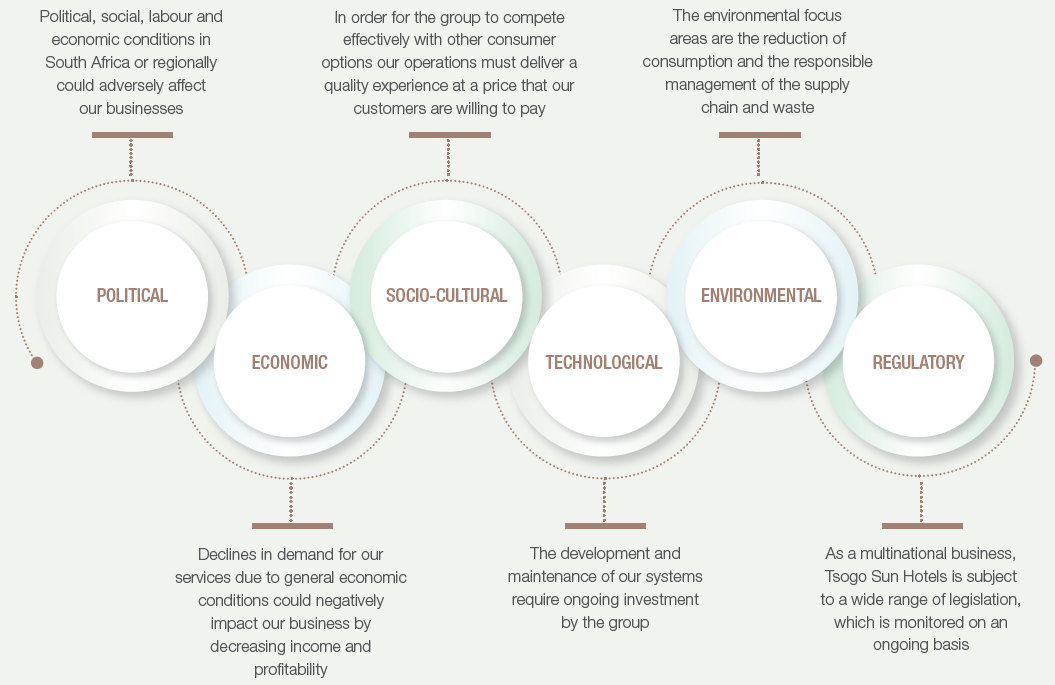
Although Tsogo Sun Hotels operates primarily in South Africa, it also has operations in Mozambique, Nigeria, the Seychelles, Tanzania, the United Arab Emirates and Zambia. Political, social, labour and economic conditions in South Africa or regionally could adversely affect our businesses.
The group is based in and derives the vast majority of its income from operations in South Africa. As such, the political conditions in South Africa have a significant influence on our business. South Africa faces many challenges in improving levels of social and economic development among its people. To the extent these challenges are not overcome, there may be a negative impact on the South African economy and, in turn, the group’s results of operations.
There has also been regional political instability in some of the countries surrounding South Africa. The potential for resulting political instability in the region could negatively affect the South African economy and political environment, which, in turn, could have a material adverse effect on the group’s operations, profitability, cash flows and financial condition.
TECHNOLOGICAL
The group’s businesses demand the use of technology and systems for property management, brand assurance and compliance, procurement, reservation systems, surveillance, operation of our customer reward programme, booking of hotel accommodation by current and future customers, search engine optimisation and guest amenities. The development and maintenance of these technologies require ongoing investment by the group.
Technology trends most relevant to our industry being:
- Availability of robust broadband
- Advanced and secure mobile functionality for transacting and communication (customers and operational staff)
- Integrated tools to ensure customers are rewarded equitably based on spend/value
- Improving staff productivity and reducing costs
- More cost-effective IT business models
SOCIO-CULTURAL
The group must continually refresh its product offering to cater to consumer preferences. In order for the group to compete effectively with other consumer options for leisure and entertainment activities, as well as other hotel and leisure providers, our operations must deliver a quality experience at a price that our customers are willing to pay. The experience must also cater to various changing consumer preferences in the market. Consumer preferences range from technology preferences (such as the increased utilisation of mobile devices and social media) to the look and feel of the physical product, the location of buildings, concepts of restaurants and bar offerings and types of entertainment and travel patterns.
ECONOMIC
Demand for our hotels is linked to the performance of the general economy and is sensitive to business, government and personal discretionary spending levels. Decreased global or regional demand for our products and services can be especially pronounced during periods of economic contraction or low levels of economic growth, and the recovery in the hotel industry may lag behind overall economic improvement.
The group’s reliance on the business and government traveller markets as core components of its customer base makes it particularly sensitive to economic conditions that cause declines in travel by those groups. Declines in demand for our services due to general economic conditions could negatively impact our business by decreasing the income and profitability.
The group has a high concentration of hotels in particular urban centres. While this strategy helps to ensure that we can service a large number of travellers in these key markets, from budget to luxury, it also increases its sensitivity to adverse conditions affecting travel to such areas. Any events or developments that reduce the demand for our services in these core urban centres could negatively impact our business. We are currently experiencing this with the ban on non-business- related inter-provincial travel to contain the spread of COVID-19.
In addition, many of the expenses associated with the hotel business, including personnel costs, interest, rent, property taxes, insurance and utilities, are relatively fixed. During a period of overall economic weakness, any failure by the group to meaningfully reduce these costs as demand for our rooms decreases may have a material adverse effect on our operations, profitability, cash flows and financial condition.
ENVIRONMENTAL
Our business poses limited risk to the environment due to the service nature of the industry. The fact that we operate predominantly in urban areas, further reduces the biodiversity impact. The main environmental impacts of the group are the consumption of energy and water, the production of waste and travel of guests to our properties.
Although customer choices are not yet significantly impacted by environmental policies, behavioural changes are being driven by social responsibility. The environmental focus areas are the reduction of consumption through innovative physical property and behavioural changes and the responsible management of the supply chain and waste.
The greater challenges to the hotel industry currently are the rising utility costs and uncertainty surrounding the supply of energy and, particularly, the future supply of water. Administered costs have seen a sustained above inflation increase over the past number of years. These include property rates, and the cost of heat, light and power. Whilst we have undertaken numerous steps to reduce our electricity and water consumption through employing efficient operating methodologies, the price per unit of these utilities has increased dramatically and is worsened through the requirement to fund generating capacity (diesel generators) during load shedding. Municipalities have come under increasing pressure to raise independent funding and this has led to substantially higher property rates being imposed on the group’s portfolio.
REGULATORY
As a multinational business, Tsogo Sun Hotels is subject to a wide range of legislation, which is monitored on an ongoing basis. Any breach of compliance with this legislation could result in fines or sanctions that affect our profitability and may have adverse reputational consequences.
B-BBEE
Under the laws, codes and regulations promulgated by the South African government to promote B-BBEE, the government awards procurement contracts, quotas, licences, permits and other rights based on numerous factors, including the B-BBEE status of applicants. We are committed to complying with these requirements, which are designed to redress historical social and economic inequalities and ensure socio-economic stability in South Africa. A company’s B-BBEE status is an important factor considered by government and other public bodies in awarding contracts and may influence relationships with customers or suppliers as it contributes to their B-BBEE status. Given that government travellers comprise a core segment of our revenues, our Level 1 B-BBEE contributor status is important in securing this business.
Tax legislation
Changes in tax legislations across the jurisdictions of operation could adversely affect net results for future periods and affect the group’s business, financial condition and results of operations.
South Africa has a stable tax environment and the tax administration system is advanced and transparent in many aspects. Other jurisdictions of operation, including Zambia, Mozambique, Nigeria, Kenya and the Seychelles have differing tax legislation by which the group must additionally abide.
Health and safety legislation
Current legislation in South Africa imposes significant health and safety regulations on the group’s operations which will continue in the post COVID-19 environment. Health and safety is ingrained in our culture and we have a high standard of compliance in this area.
Consumer privacy and data protection legislation
The group is subject to regulation General Data Protection Regulation (‘GDPR’) and Protection of Personal Information Act 4 of 2013 (‘POPIA’) regarding the use of customers’ personal and credit card data and the protection of such data from cyber-theft. The group receives and processes large amounts of sensitive personal customer data (including name, address, bank details and credit card details) as part of its business and as a result must comply with strict data protection and privacy laws in the jurisdictions in which the group operates.