STRATEGIC REVIEW AND IMPACT ON PRIORITIES
Due to the significant impact that COVID-19 had on the group and its operations, it is important, given the information available to us at the date of finalising this report, to review its impact on our strategic priorities and future growth prospects.
Strategic priorities are internal drivers that are largely known and can be directly influenced by management and our relationships with major stakeholders. Future growth prospects are largely externally driven, and while management has the ability to lobby government through industry bodies for the accelerated opening of the economy with due regard for safety protocols, our growth prospects are uncertain at this stage and depend largely on the recovery of the South African economy. Economists and analysts currently expect market conditions and socio-economic imbalances to push South Africa to an ‘L-shaped’ recession depicted by a steeper economic decline and a very prolonged recession. This deeper recession often accompanies credit rating downgrades, as we saw towards the end of March 2020. In conjunction with the national lockdown in response to COVID-19, the recession is likely to result in corporate defaults, bankruptcies and retrenchments, as companies grapple with access to capital and restructuring operations to fund and reduce cash burn. Companies that are agile and flexible in responding to the financial and operational pressures imposed by the pandemic will fare better.
The recovery of the hospitality industry specifically is expected to be slow due to the uncertainties around the health of travellers, and the negative economic impact on government, corporates and individuals leading to reduced spend on hotel accommodation and conferences.
POTENTIAL IMPACT ON STRATEGIC PRIORITIES AND FUTURE GROWTH DRIVERS
 |
Deliver to our beneficiaries The HCI shareholding following the listing and unbundling was 49% in Tsogo Sun Hotels and it remains important from a B-BBEE perspective. As outlined in our pre-listing statement, the group intended to apply cash resources generated during the initial 15 months post-listing towards the settlement of our offshore division’s US Dollar denominated interest-bearing debt. Given the anticipated extended period of minimal revenue, the directors considered it prudent to retain cash resources in order to ensure that the group is able to navigate this difficult period until trading resumes. With unutilised facilities and cash of R1.7 billion as at 31 March 2020, and with hotels beginning to operate, albeit under restrictions at this stage, we do not anticipate the need to launch a rights offer in order to fund our operations. With the deactivation of the group’s hotels, all community investment and sponsorship activities were suspended. Remote business support continued to be provided to registered beneficiaries of the Tsogo Sun Entrepreneurs programme. The group is also seeking rent relief from landlords for the lockdown period and subsequent low demand periods. Negotiations in this regard are ongoing. In addition, the group has negotiated reduced or extended payment terms with major suppliers, particularly those providing fixed cost services such as security and lift maintenance. Municipal rates and taxes are a material fixed monthly cost for the group and while we currently continue to meet these obligations, we are lobbying government through industry bodies to grant a deferral or payment holiday. Contractual variable costs with suppliers were reduced to nil until trading resumes by extending the period of the contracts. |
|||||
 |
Financial strength and durability Gearing levels for both Tsogo Sun Hotels and Tsogo Sun Gaming prior to the listing and unbundling were carefully considered, based on the respective businesses’ risk profiles including cash flow generation, earnings volatility and cyclicality. Tsogo Sun Hotels retained two key debt funding packages:
|
|||||
 |
Product relevance to customer experience The group has a history of continuous investment in our product in order to deliver great experiences to our guests. Capex consists mostly of maintenance and refurbishment capex required to keep the hotels in optimal operating condition. The group maintains a rolling five-year capex planning system to identify hotels requiring minor and major refurbishment, as well as plant and infrastructure requirements. The maintenance capex programme on the hotel operations in the year amounts to R366 million (2019: R384 million) and includes major refurbishment spend at Westin Cape Town, Garden Court Hatfield, Southern Sun Ikoyi and Southern Sun Lusaka. In addition, the lifts at Southern Sun Cape Sun are undergoing replacement. The balance of the programme consists of ongoing refurbishments across hotels, annual unit-based capex (including operating equipment) and investment in information technology (‘IT’) hardware, primarily Wi-Fi related. Due to the size of the Westin and Southern Sun Lusaka refurbishments, the current capex programme is elevated and is expected to moderate in coming years. The group has a long-term target of maintenance capex not exceeding 25% of Ebitdar on a rolling basis. This excludes inorganic investments we may undertake to expand our operations. As part of our COVID-19 action plan, the group suspended all capex with only emergency capex and repairs and maintenance to be considered in order to preserve cash. |
|||||
 |
Regulatory compliance The South African regulatory environment continues to become more complex with the ongoing introduction of new legislation, rulings, practices and policies. The advent of COVID-19 has complicated this landscape further with numerous directives and practice notes released by the JSE providing guidance to issuers to protect investors and other stakeholders through enhanced financial and qualitative disclosures relating to the impact of COVID-19. The group continues to comply with these guidance notes where relevant. The main regulatory impact on our business as a result of COVID-19 are the health and safety regulations introduced by government. With our culture of high customer health and safety standards, the group was well placed to comply with these regulations and worked closely with government and the Tourism Business Council of South Africa (‘TBCSA’) to develop the health and safety protocols for the tourism industry as a whole. Since we already have a high level of compliance in this area, the implementation of these protocols is not expected to require material capex spend. |
|||||
 |
Human resources Our well-trained and engaged employees are key to our delivery of great experiences to our guests. Where our staff are employed at our properties that were repurposed for use as isolation and quarantine facilities, as well as to provide accommodation for health and essential workers, strict safety rules are adhered to and comprehensive training is provided. Following the move to level 3 of the national lockdown and in anticipation of the reactivation of hotels, the group has a number of health protocols and control measures to safeguard our employees. These measures include employee training, personal protective equipment and hygiene resources, social distancing and screening as well as increased sanitation and hygiene processes. Tsogo Sun’s digital learning platform provides COVID-19 modules that employees can access remotely to stay informed. We understand that this is an extremely stressful time for our employees and we are committed to engaging with them openly and honestly. On 20 March 2020, the group made an internal announcement to all management and staff sharing the severe impact that COVID-19 and the national state of disaster are expected to have. We consulted with employees to reach an agreement on the terms and conditions for a temporary layoff of staff. Subsequently, at the end of March, a skeletal operating structure was established. The group applied to the UIF TERS to supplement the reduced remuneration of employees who were temporarily laid off. As developments unfold, the necessary adjustments to the basis of the layoff will be reviewed against operational requirements. The group published a COVID-19 human resources policy to inform behaviour and safeguard our people’s health at the workplace when business resumes. The Tsogo Sun Group Medical Scheme responded swiftly to COVID-19, ensuring members and their beneficiaries receive the appropriate level of cover and communication during this period. However, it is still too early to determine the impact on the scheme. |
|||||
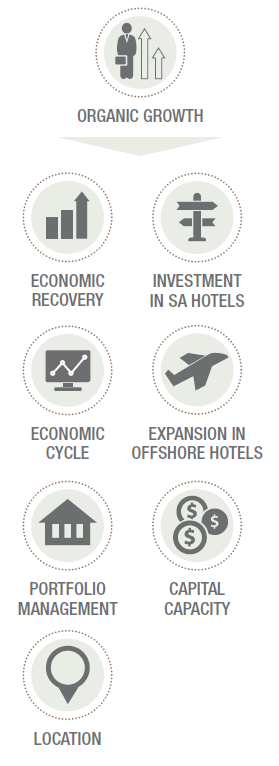 |
Organic growth Based on current trading, we expect the recovery in occupancies to pre-COVID-19 levels to take at least 18 to 24 months. In response to the excess supply in the market, and as part of our phased reopening plan, the group has only reactivated half of its portfolio in phase 1 under level 3 of the national lockdown and this could be revised depending on demand. Phase 2 hotels will be reactivated once inter-provincial leisure travel is allowed based on anticipated demand. The remaining hotels are not expected to be reactivated for an extended period of time, which are generally those that are reliant on international inbound travel and significant groups and conferencing business. With excess supply in the market and a lack of demand, average room rates will be under pressure. We are thus focused on ensuring that we are the lowest cost operator in the market so that our hotels remain profitable even at the reduced pricing and occupancy levels. One benefit of the current market conditions is that there should be a respite in new rooms supply to the market for at least the next three to five years. |
|||||
 |
Inorganic growth In this constrained growth environment and with the group utilising available cash and debt facilities to fund operations while the economy recovers from the impact of COVID-19, inorganic growth is not our focus for the short to medium term. |
(1) Earnings before interest, taxation, depreciation and amortisation (‘Ebitda’).