Joint statement
From the chairman and
chief executive officer
Non-executive Chairman
As we reflect on the 2024 year under review, we are proud of what our team has managed to achieve since the pandemic began.
Chief Executive Officer
From separately listing on the JSE in June 2019 to the closure of most of our hotels a mere nine months later, the group entered the pandemic with R3.3 billion in interest-bearing debt. Four years later and we have de-risked the balance sheet, reducing debt to R1.0 billion principally through the sale of assets: the ultra-luxury Maia hotel in Seychelles and the Southern Sun Ikoyi hotel in Nigeria. These transactions generated US-dollar proceeds equivalent to R1.2 billion and allowed us to reduce our foreign exchange risk by settling a significant portion of US-dollar denominated debt.
While navigating the pandemic was an extremely difficult time for the group, it did provide us with an opportunity to reconsider every operating department in the business and whether it was appropriately sized or even necessary at all. At the same time, the outright acquisition and delisting of Hospitality further simplified the group, eliminating the cost of maintaining two separate listings and the burden of declaring distributions to comply with REIT legislation.
The message internally across our operational management teams is that in our business of high volume, low value transactions; every unnecessary expense or missed opportunity to sell a room is material. The discipline of retaining these operational efficiencies together with our hotel distribution and well-recognised brands, means that we are well-positioned to benefit from growth in South African tourism.
Operations
Revenue for the year was largely driven by room rates with average room rates increasing by 10% from the prior year. This is attributable to strong tourism, business travel and event-related demand, particularly in Cape Town where the group has significant exposure. Luxury hotel guests have proven more resilient to prevailing economic pressures such as inflation and rising interest rates, being influenced more by location and personal preference rather than price.
The group’s occupancy at 58.6% reflects the low growth economic environment prevalent in South Africa. We are optimistic that under the newly elected Government of National Unity there will be more certainty regarding government policy and that private sector collaborations initiated to solve the myriad of challenges facing the country will gain traction. Pent-up demand for travel and accommodation by both domestic and international corporates as well as government should begin to materialise, benefiting the group’s hotels in both Gauteng and KwaZulu-Natal which are weighted towards these segments.

Despite occupancies still being below pre-pandemic levels, operational efficiencies have improved profitability, and the group achieved a 32% Ebitdar growth to R1.9 billion from a 19% growth in revenue, a record for Southern Sun. Regional contribution to Ebitdar is set out in the charts below and the Western Cape is the group’s best performing region contributing 44% to total group Ebitdar with hotels capitalising on strong foreign inbound travel and eventing demand. Gauteng continues to contribute 19% to overall group Ebitdar, however, this region’s performance is bolstered by the solid performance of hotels located in prime business hubs near OR Tambo International Airport and Sandton Convention Centre, with the latter hosting the 15th BRICS Summit in August 2023. Hotels outside of these nodes have not yet fully recovered but are showing signs of improvement. Since the group only retains fee income from the lease of the Sandton Consortium hotels, they have been excluded from the Gauteng region.
KwaZulu-Natal has had a difficult year and, while it was the group’s strongest region during the pandemic when it benefited from domestic tourism as well as corporate and government business due to its proximity to Gauteng, its Ebitdar contribution has reduced to 16% of total group Ebitdar. Durban has struggled to attract tourism as the negative PR about issues such as polluted sea waters and the after-effect of the July 2021 riots impact public perception of the city. Corporate demand has also relocated to uMhlanga where the group is currently underrepresented. Even government demand lagged in the lead up to the elections as fears of unrest kept travel to a minimum. However, we are optimistic that the newly elected provincial government will continue its commitment to rebuilding and improving conditions in Durban.
Following the sale of our Nigerian hotel, which accounts for the decline in Ebitdar contribution from the Offshore division, Mozambique, Seychelles and Zambia are now the largest contributors to Offshore Ebitdar. Despite development delays in the oil and gas sectors in Mozambique, Southern Sun and StayEasy Maputo achieved Ebitdar growth of 37%, benefiting from shipping business redirected from Durban’s port. The Paradise Sun hotel in Seychelles met trading expectations thanks to support from the European market. Trading at Southern Sun The Ridge in Zambia was muted due to its reliance on corporate travel from South Africa which has not recovered to pre-Covid-19 levels, however, business has improved within the sports, government, and NGO segments. The process of re-opening the Southern Sun Dar es Salaam in Tanzania, which is the only group hotel still closed since the pandemic, is currently underway and is expected to be completed in October 2024.
Download full statement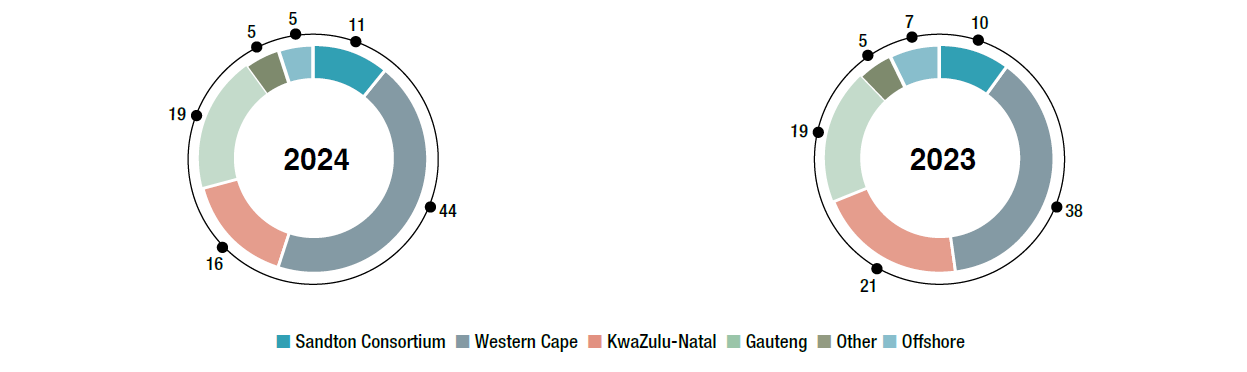
Note: Investment properties have been collapsed into the province in which the hotels are located, and the Manco segment has been incorporated into the Other segment.
